The Wife Who Waved Until She Thought I Couldn't See
From the last car of the troop train I watched my wife wave until she thought I couldn't see her anymore. Then she turne...
10 chapters
The fire chief read the cause of her fire aloud from a report he'd typed before the last truck left.
Ruth Ann Coker is 63, a retired school cafeteria cook and a widow. The five acres at the end of County Road 9 are paid for. That is the whole of what she owns.
Eleven days later her adjuster denied the claim off the chief's report. Four days after that, the bank nailed a foreclosure notice to her door.
She never argued with the report. She asked one question three different ways: Did the tanker reach my hydrant?
Nobody answered her. The county paper reprinted the chief's cause word for word, with her address in it. The feed store asked her not to come back. Two women she had fed for forty years crossed the street.
She walked down her lane and looked at the hydrant herself. The brass cap was still painted shut.
That was the first thing that didn't fit. The second was the boy - Junior Purdy, nineteen, the chief's sister's son, still rinsing soot off his boots at 6:40 the next morning, when no water had been used on her property.
She kept a notebook page the way she kept her bills. Dates. Times. What the chief said in the yard.
Then she found the coffee can.
It sat under the pump housing of the 1996 tanker, catching an oil-and-water drip that never stopped. Every annual pump test in the hall's file was signed in the same green pen - not one had a flow reading written in.
That was when Ruth Ann thought she understood. The chief was protecting the equipment budget: a dry tanker, and a cause of fire that made the dry tanker nobody's problem. Everyone in Two Rivers thought the same thing. Everyone was wrong.
Bo Traywick didn't rewrite that report to save a pump. He rewrote it to save his nephew.
The run sheet from that night carries one name on the water-supply line: J. Purdy. Alone, at the hydrant. And the training file Bo signed lists the boy hydrant-qualified with zero logged hours.
Bo's typed report says he wrote the cause on scene at 6:10 the next morning. The department's own carbon copy, the yellow sheet under the clean report in his own handwriting, reads: pump test - no flow, 9:41 p.m.
Nine forty-one. The fire was still burning.
Marlene Estep had typed every report in that hall for nineteen years, and kept the carbons in her own drawer. She mailed it inside a Christmas card, because she hated being lied to about times.
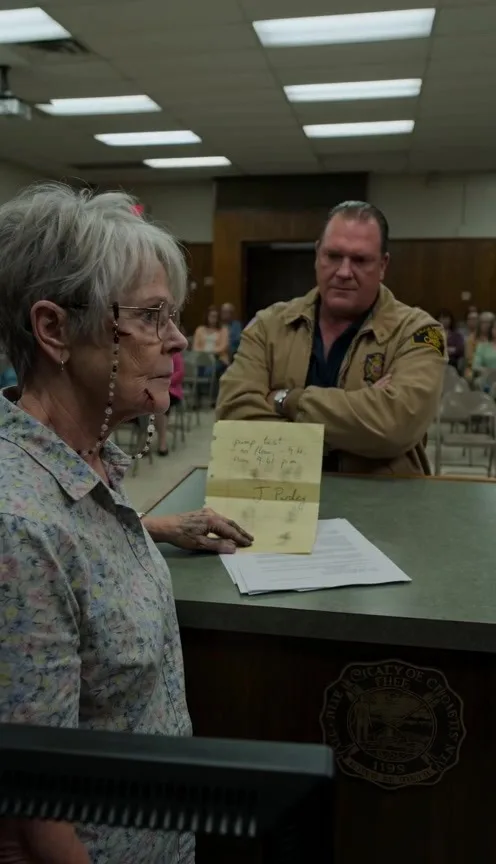
Six weeks later, in the commission room at the old courthouse, Ruth Ann laid that yellow sheet on the podium beside the chief's clean typed report and said five words.
Read it out loud, Chief.
Behind her, a folding chair scraped the tile. Marlene stood and told the room the time she had actually typed that report. In the third row, the state fire marshal's auditor turned a page in the pump-test binder.
The claim was paid. The foreclosure was withdrawn. The 1996 tanker was backed onto a flatbed in her yard, chalked OUT OF SERVICE, and that week the chief's helmet came off its hook.
Ruth Ann thought that was the end of it.
Then she read the carbon again, all the way down the page.
Under the same date, in different handwriting, is a second entry: a fire two years ago that nobody in Two Rivers ever asked about.
Whose handwriting is it - and what burned that night?
Table of contents
Keep reading
From the last car of the troop train I watched my wife wave until she thought I couldn't see her anymore. Then she turne...
My flight got canceled and I came home early. My boss was in my bed. My wife pulled the sheet up and couldn't look at me...
I work nights. I live on nineteen. For five hours in a stuck elevator, a stranger told me all about the girl on nineteen...
I came home from the war three weeks ahead of my letter, and went up my own stairs in my uniform. My wife pulled our qui...