Chapter 1
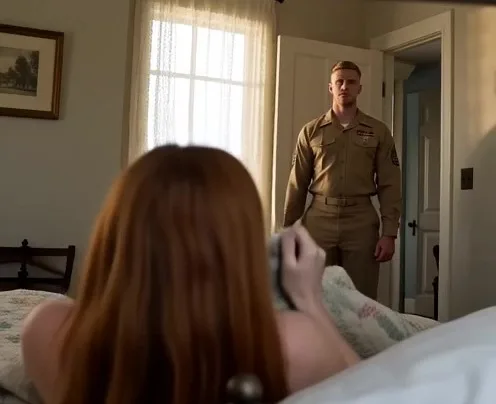
I came home from the war three weeks ahead of my letter, and went up my own stairs in my uniform.
My wife pulled our quilt to her chin.
The foreman of the only plant in town stayed right where he was, on my pillow, and said, "You're early, soldier."
He signed my father's pay.
He signed the paper that kept my sister's husband out of the Pacific.
He smiled because he knew all that.
He didn't know what was in my duffel.
It was ten inches of cracked engine steel with his plant's stamp on it, out of the bomber that took four of my crew.
There was a man's straw hat on the newel post, and I took it for my father's.
It was a hot Thursday afternoon, June 28, 1945, in New Antrim, Ohio, where nobody locked a door.
The 2:40 from Columbus had let me off at the depot twenty minutes before.
I stepped over the third stair because it creaked, and I wanted to see her face.
I could have wired from the separation center in Indiana, and I didn't, and nobody made me.
I'd had nineteen months overseas to picture walking in on her, and I wasn't giving that up for the price of a telegram.
I was twenty-nine, a technical sergeant, flight engineer on a B-25.
You needed 85 points to come home after Germany quit, and I had 96.
The Army found me a seat on a transport while my letter was still waiting on a boat.
The Air Medal, the Purple Heart and the theater ribbon were pinned over my left pocket.
The duffel in my right hand weighed more than clothes weigh.
Under my shaving kit, in a greased rag, was a link rod, the steel arm behind a piston, out of the left engine of the bomber that quit on takeoff in April.
It was cracked across the shank, and stamped next to the crack was a little diamond with an A in it.
My father had worn that diamond on his badge for thirty years at Antrim Tool & Die, the only plant in town.
My plan was simple.
I'd kiss my wife, and then I'd ask her how a cracked rod gets that stamp.
Imogene was twenty-seven, and she would know.
She wrote me in '43 that she had gone on inspection at the plant, and that nothing she passed would ever go up that she wouldn't put me behind.
I carried that letter through every mission I flew.
The bedroom door stood half open for the heat.
I pushed it with two fingers.
Imogene was sitting up in our bed with her long hair loose over my mother's quilt, the double wedding ring she pieced the winter before she died.
A man's white shirt hung on my chair with the tie folded over it, and his shoes sat side by side underneath, the way you leave them when you've done it before.
She grabbed the quilt and pulled it to her chin.
He didn't reach for anything.
He lay back on my pillow, looked at the ribbons on my chest and smiled.
"You're early, soldier."
It was Merle Ketcham, thirty-three years old, in his undershirt, the foreman who hired and fired all 412 people at the plant.
The draft board had him down as too essential to send.
I added up that smile in about the time it takes to read a gauge.
My father was sixty-one and ran a bench on Merle Ketcham's floor.
My sister had written me that her husband, Alvin, had a draft board hearing Tuesday morning, and the paper that kept him home needed Merle Ketcham's name on it.
The cashier at the bank that held the note on this house played pinochle with him every Friday.
Down the block somebody's radio was playing "Sentimental Journey."
The duffel slid out of my hand and hit the floorboards with a knock no laundry makes.
"Clyde," Imogene said into the quilt.
Merle read every ribbon I had, left to right, and never once glanced at the duffel by my foot, and that was his first mistake…