The Wife Who Waved Until She Thought I Couldn't See
From the last car of the troop train I watched my wife wave until she thought I couldn't see her anymore. Then she turne...
10 chapters
Dane wiped the whiteboard his uncle hadn't written on in nine years, then said, "Nothing today either, Uncle Amos."
The old man in the chair didn't answer. He hadn't answered anyone since the stroke, and by then the whole house had agreed on that version of events.
Junie Marsh was nine years old. She was the bookkeeper's daughter, which made her nobody, which meant nobody watched where she went.
That first afternoon she wandered into the east wing because the door stood open and the hallway was warmer than the lane.
She said hello to the man in the chair. He didn't look at her. He didn't look at the window, or the television, or the door. He looked at the whiteboard on the wall behind his head - close enough to touch, and spotless.
That was the first thing that didn't fit. Every other surface in that room wore dust. The sill, the shelf, the little table of pill cups. The whiteboard was the only clean object in it.
The staff called him Mr. Kettering and discussed him in the third person while he sat right there in the room. Everyone had gotten used to it. Junie hadn't.
She asked him what he was looking at. Nothing. She asked again the next day, in different words. Same nothing.
So she started standing in the doorway at six o'clock.
That was when his nephew came in with a rag.
Dane Kettering ran the farm. He held the power of attorney, the checkbook, and the county's good opinion, because he had stepped up when his uncle went down. He wiped that board slow, corner to corner, the way a man reads a page he can't find.
"Nothing today either, Uncle Amos," he said, warm as a Sunday.
Junie didn't think it was cruel. She thought it was strange. Why would anybody wipe a board nobody wrote on?
Dane was kind to her, too. He slipped her peppermints out of the office jar and asked about school and never once told her to get out of the barn aisle. That was the part she kept coming back to later.
Her mother had told her not to bother the family. Her mother had also cried in the truck twice that month, which Junie had pretended not to see.
Della Marsh had been bookkeeper at Kettering Hall for eleven months. She reconciled the feed accounts, ordered vet supplies, and said good morning to the man in the east wing every day without once meeting his eyes.
She had her reasons. Her father was in a state facility forty miles away, sixty-eight years old, with a heart that was quitting on him, serving year nine of twelve for a barn fire he did not set.
Everyone said Amos Kettering had let it happen. Everyone said his mind went with his speech. Della believed that for nine years - it was why she took the job - and she had spent eleven months going through the trust records at night and finding nothing. Not one line that explained what happened to her father.
Then a marker cap rolled under the whiteboard.
Junie had been flicking it against the wall, the way you do when you're nine and bored and nobody has told you to stop. It skittered behind the board, and she reached under with two fingers and felt the frame move.
Not the board. The frame around it. Loose at the bottom corner, as if something had been slid in and never taken out.
She pulled.
Behind the aluminum edge was a folded page, yellowed at the creases, torn out of a farm ledger. It had been there long enough to take the shape of the frame.
She could only read part of it. The date at the top. A name - OWEN PIKE. And initials at the bottom in shaky black ink: A.K.
Owen Pike was her grandfather. She had met him four times, through glass.
She carried the page into the kitchen and laid it on the table and waited.
Della came in with the feed invoices and stopped moving.
She read it standing up. Then she sat down on the floor with her back against the cabinet, which is where Junie found her twenty minutes later.
It was dated March 4, nine years earlier, written in the afternoon, in Amos Kettering's own hand.
It said the foaling barn fire started at a heat lamp that had been moved up against two drums of thinner. It said Dane Kettering had been warned about both, in writing, the January before. It said the night foreman, Owen Pike, wasn't on the property until after eleven and had nothing to do with any of it.
And at the bottom, in the same shaking hand: "I AM TAKING THIS TO FERRIS AT EIGHT."
Ferris was the county attorney.
For one ugly second Della thought she was holding a confession - that Amos had written it to keep it quiet. Then she read the last line again, and the floor dropped out of the room.
Nine years of hating a man in a chair. And the man in the chair had written her father's innocence down, folded it, and hidden it three feet behind his own head.
So Della did the thing nobody in that house had done in nine years. She walked into the east wing, sat down in front of him, and held the page up where he could see it.
He looked at it a long moment. Then he looked at her.
She put a black dry-erase marker in his hand.
His fingers were bad. It took him a while. When he was done, two words sat on the whiteboard in crooked capitals:
NOBODY ASKED.
Della called the sheriff's records office that afternoon. The dispatch log from that night is still on file.
It shows a call placed at 1:12 a.m. The farm's own incident report shows Amos Kettering found on the office floor at 9:40 p.m.
Almost four hours. Nobody had ever asked what happened in between, because nobody had ever needed to. The story was already finished. The only man who could correct it couldn't speak.
Friday morning, 9:00 a.m., the farm office. The buyer's attorney slid the contract across the mahogany table - fourteen million dollars for the road frontage. Dane's pen was already moving.
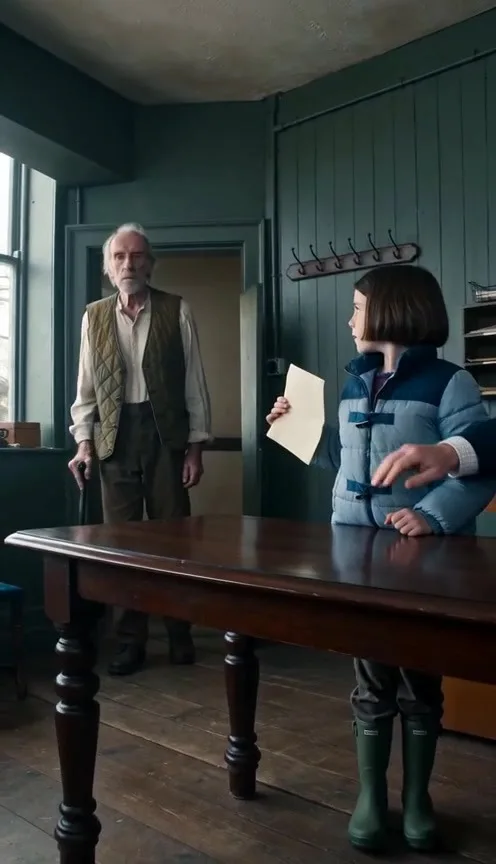
Junie walked in and laid the folded page flat across the signature line.
Dane's voice went flat. "Put that down."
She didn't.
His hand came across the table. She slid the page clear and held it up, and the date and the name and the initials were right there for the whole room to read.
Then three taps of a cane sounded in the hallway behind her.
Every head turned.
Amos Kettering was standing in the doorway of the office he had not entered in nine years, in his barn vest and white shirt, jaw working.
The room went completely silent.
Nine years of silence, and it ends in that doorway.
Table of contents
Keep reading
From the last car of the troop train I watched my wife wave until she thought I couldn't see her anymore. Then she turne...
My flight got canceled and I came home early. My boss was in my bed. My wife pulled the sheet up and couldn't look at me...
I work nights. I live on nineteen. For five hours in a stuck elevator, a stranger told me all about the girl on nineteen...
I came home from the war three weeks ahead of my letter, and went up my own stairs in my uniform. My wife pulled our qui...