Chapter 1
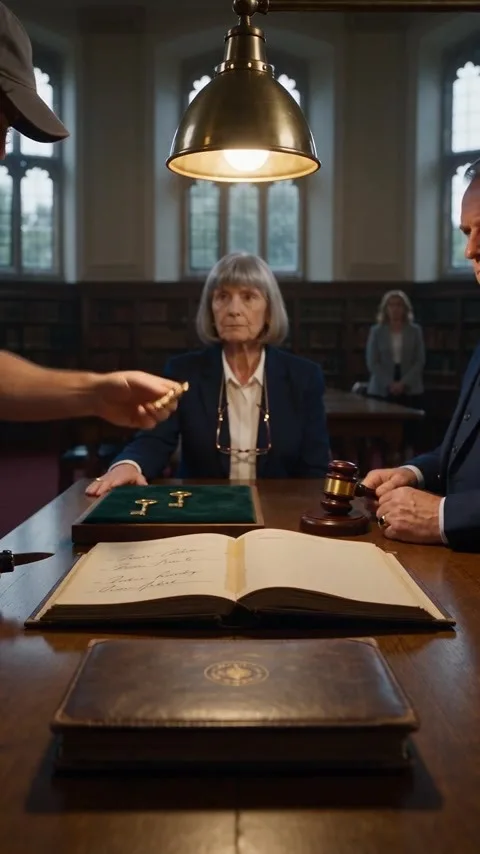
Dr. Cornelia Voss had been standing in front of the portrait for eleven minutes, and the tour group had stopped pretending to look at the ceiling.
"Plywood," she said.
She had one glove off and a loupe on a cord, and she was holding the bottom corner of the frame away from the wall with two fingers, gently, the way you hold a door for someone you dislike.
"The backing board is plywood. Machine-cut, resin-bonded, and it does not belong to 1928. Colonel Edmund Ashcombe, Josiah Pell, 1771 - this is a copy. A good one. On a period stretcher, in a period frame, fastened with period screws. Whoever hung it wanted it to survive eleven minutes in front of me."
Somebody in the tour group said, "Oh," quietly, the way people do when a guide tells them a thing is original and then tells them it isn't.
Delia Fontaine stood at the far end of the refectory table with the catalogue open under her hand. She had been curator of Ashwood for nineteen years. She had catalogued that portrait herself, in green ledger ink, in a hand that had not changed since she was thirty-five. She had written its condition report eleven times.
She did not say anything.
Ward Ashcombe came in from the terrace with his phone in his hand and his trustee's signet ring catching the light. He was forty-nine, tall, going soft at the middle, warm in a room and cold in a hallway. He looked at Voss. He looked at the painting. He looked, last, at Delia, and he held it exactly long enough for forty people to follow his eyes.
"Delia," he said. "Is this true?"
"You hired her to answer that," Delia said.
"Answer it anyway."
"Yes. It's a copy."
The room made a sound. A docent badge clicked against a brass stanchion. Outside, under the white tents, four hundred ticket-holders were eating cucumber sandwiches and waiting on the 2:30 garden walk, and the noise of them came through the tall windows like weather.
Ward put his phone in his pocket. "Walk with me," he said.
He walked her down the drive himself. That was the part she would think about later - not the accusation, not the forty people in the library, but the fact that the eldest son of the house put his hand flat between her shoulder blades and steered her out the front door, past the urns of white geraniums, onto the gravel, in the two o'clock sun, in front of four hundred people who had paid forty dollars each to see the inside of a house she had spent nineteen years keeping.
He did not raise his voice. He never did. He said, pleasantly, loud enough for the woman with the lanyard, "I'm sorry. This is a personnel matter."
Her glasses hung on their brass chain and did not come off. Her boots made the only sound. Gravel, gravel, gravel, all the way to the gatehouse, where Al Cerrone came out of the lodge with his hat in his hands and would not look at her.
At the bottom of the drive, where the gravel met the township road, Ward took his hand away.
"Your lease runs to September," he said. "Don't come back before then."
Delia turned around. She looked back up the drive at the house - the stone, the tulip trees, the tents, the docents, the open front door with the black-and-white marble hall behind it, and the glass case on the mahogany console opposite the stairs.
Four brass mounts on green velvet. Three keys.
The fourth mount was bare, and its velvet was a dark, unfaded green in the exact shape of a key bow.
She said one sentence, and she said it to Ward, and she said it quietly, because it was the only sentence she had left.
"Ask who cut the fourth key."
Then she walked to her car.
Nobody asked.