Chapter 1
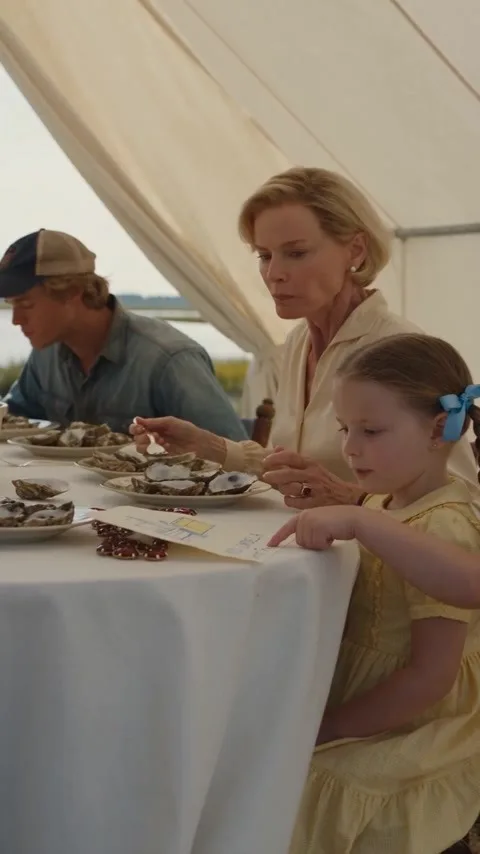
The oyster knife was still in Willa Gadsden's hand when the garnet case slid out of her apron and hit the white tablecloth.
It landed on a corner. The lid sprang. Three garnets rolled across the linen and stopped against a plate of lemon wedges, dark as dried blood.
Ninety guests under the tent stopped talking at once.
Cordelia Prescott was already standing. Willa thought about that later - how Cordelia was on her feet before the case had finished rolling.
"That," Cordelia said, and her voice cracked in exactly the right place, "is Adeline's parure. It has been missing from my mother-in-law's room since Tuesday."
Willa looked down at it. She had pressed that cloth. She had pressed every cloth on that table, and the napkins, and the long runner down the middle, with a hand iron in a hot pantry, for forty-one years.
"I didn't take them," she said.
Nobody heard her. That was not new. In forty-one years Willa had never once spoken at a family table, and a tent full of Prescotts and museum donors was still a family table.
Cordelia's hand went to her throat. The flush rose exactly where it always rose when she was lying - a pink band above the collar of her cream silk blouse - and Willa watched it and said nothing at all.
"She has the only other key to Adeline's room," Cordelia told the tent, told the museum's registrar in the second row, told the woman from the insurance company who had driven down from Columbia for the bequest announcement. "I gave it to her myself. I trusted her."
That part was true. Adeline Prescott had handed Willa the key in April, two weeks before she died, because Willa was the one who changed the linens and aired the room and kept the silver polished. Adeline had said, in her dry Lowcountry way, "You're the only one in this family who doesn't want anything from me."
Willa set the oyster knife on the tray. She wiped her hands on the towel at her waist. Then she did what she had done in that house for four decades. She stood still and let them look at her.
Trip Prescott sat at the far end of the table with his ball cap in his lap. He did not look up. June, seven years old, sat beside her grandmother with a crayon in her fist, watching everything with her father's eyes.
"Willa," Cordelia said, gently, for the tent, "I think you should go."
Two of the grounds men walked her out. Guests turned in their chairs to watch. A woman in a pink hat leaned toward her husband and murmured something, and the husband laughed, and Willa heard it the whole way to the gate.
At the gate, Loretta Pinckney caught her arm. Loretta had cooked for that family nineteen years and had opinions about all of them.
"Don't you say one word, Willa. Not one."
Willa looked back once. Cordelia was standing at the head of the table with a plate in her hand, laughing at something someone had said, the garnet case already gone. Her face was not a grieving face. It was the face of a woman who had finally set down something heavy.
Willa had spent forty-one years reading faces in a house where she was not permitted to speak. She knew then that the garnets had never been the point.