Chapter 1
Helena’s hand swept past my shoulder as if I were part of the wall. She didn’t glance at me. She pointed instead to Vivian, Corinne, and Daphne, the three daughters she had borne, the three women who had spent most of their adult lives treating Kestrel Maritime as a dividend machine.
“Vivian, Corinne, Daphne,” Helena said into the microphone, her voice warm enough for the guests and cold enough for me. “Those are my heirs. Tamsin handles administrative support.”
Four hundred people in the sea room of The Aerie heard it. The storm against the glass made the windows tremble, but no one looked toward the sound. They looked at me, standing in midnight-blue velvet with my father’s signet ring hidden beneath the neckline of my gown and a cobalt leather portfolio under my arm. Eleven years. Eighty-hour weeks. Two restructurings that had kept the shipyards from bankruptcy. And Helena had reduced me to furniture in one sentence.
Vivian smiled with pity. Corinne examined her nails. Daphne looked away.
Then Silas Voss stepped out of the shadows by the terrace doors. I knew him the way everyone on the waterfront knew him-the investor nobody invited, the one who bought distressed fleets and stripped predatory lenders to the bone. He wore charcoal, no tie, and a scar along his jaw that made his unreadable gray eyes seem almost kind by comparison.
“You have four women behind you, Helena,” Voss said. “Which one is your successor?”
Helena’s smile tightened. “I just told you. Vivian, Corinne, and Daphne represent the bloodline and future of Kestrel Maritime. Tamsin is family by courtesy. Her position is administrative.”
Voss didn’t look at Vivian. He didn’t look at Corinne or Daphne. He looked at me.
“Your portfolio, Ms. Kestrel.”
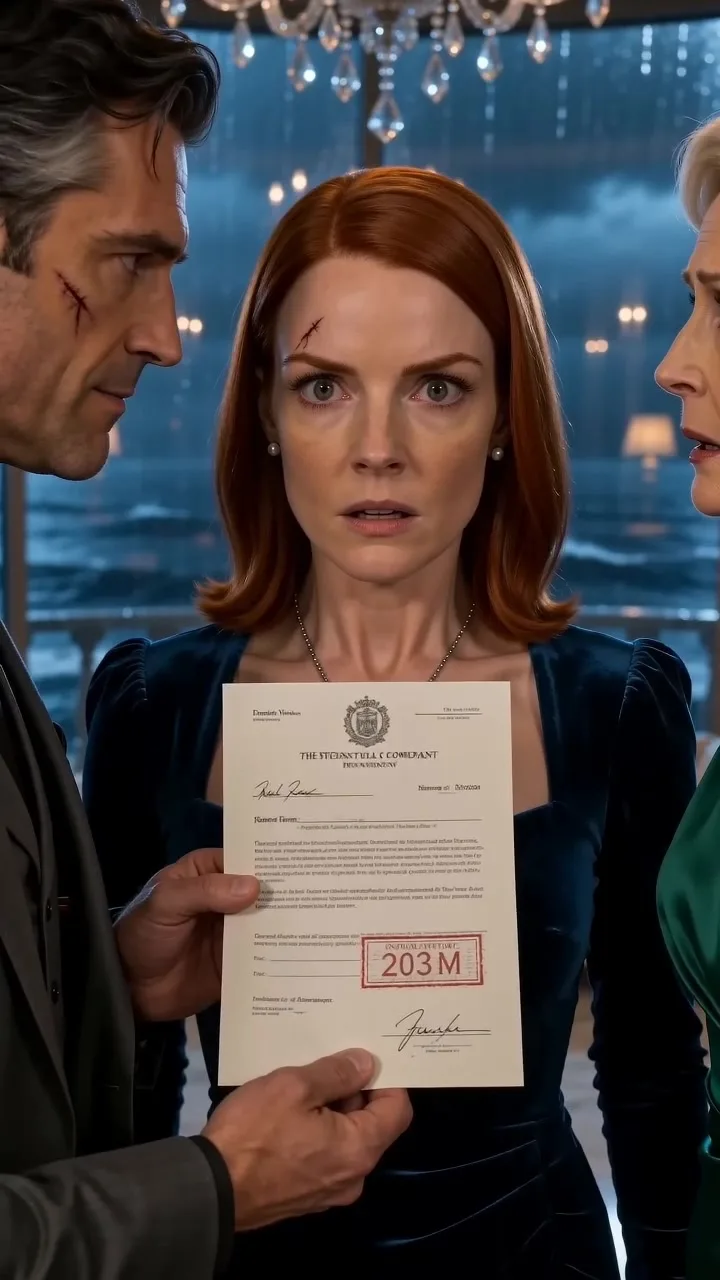
Helena said something about proprietary documents and legal standing. No one listened. I stepped forward and placed the cobalt folder in his hands. I had built it that afternoon: the full restructuring, the hedges, the terminal leases, the seven-year forensic accounting. On the first tab, in red ink, it read: Operational Losses Avoided: $203,000,000. Beneath that, every page was signed, Prepared by Tamsin Kestrel.
Voss opened it. His faint smile died.
For twenty seconds, the only sound was rain against the cliffside glass and the distant thunder over Puget Sound. He closed the folder with a snap that echoed off the marble.
“Then explain this,” he said quietly. “Port Blakely Shipyard was sold three weeks ago to Black Tern Holdings for sixty-eight million dollars. Tamsin Kestrel’s signature is on the guarantee.”
The room broke into gasps. Port Blakely was not just a yard. It was the dry docks my father had built, the deep-water heart of the company, the place where nearly four thousand shipwrights and engineers still worked.
“That’s impossible,” Helena said, too fast. Her eyes darted toward Julian Reyes, our general counsel, who stood frozen under the archway. “If any sale occurred, Tamsin acted alone. She had no authority.”
“I never signed anything,” I said. My voice sounded far away. “I would never sell my father’s yard.”
Before Helena could answer, the gallery doors banged open. Rain blew across the threshold as a man in a soaked trench coat walked straight through the guests, past security, and stopped in front of me. He held a thick envelope with the red seal of the King County Superior Court.
“Tamsin Kestrel?”
“Yes.”
He put the envelope in my hands. “You’re served. Criminal complaint for grand larceny, securities fraud, and unauthorized asset liquidation. Filed at six o’clock this evening on behalf of Black Tern Holdings.”
The room erupted. I looked down at the court stamp, then up at Silas Voss. He still held my portfolio. He didn’t look surprised. He looked like a man who had been waiting for a trap to close.
“It’s already been filed,” the server said, and walked back into the rain.
I never signed that sale. Someone had forged my name, stolen sixty-eight million dollars, and made me the criminal in my father’s own house. And Silas Voss had known about it before the court ever stamped the papers.