Chapter 1
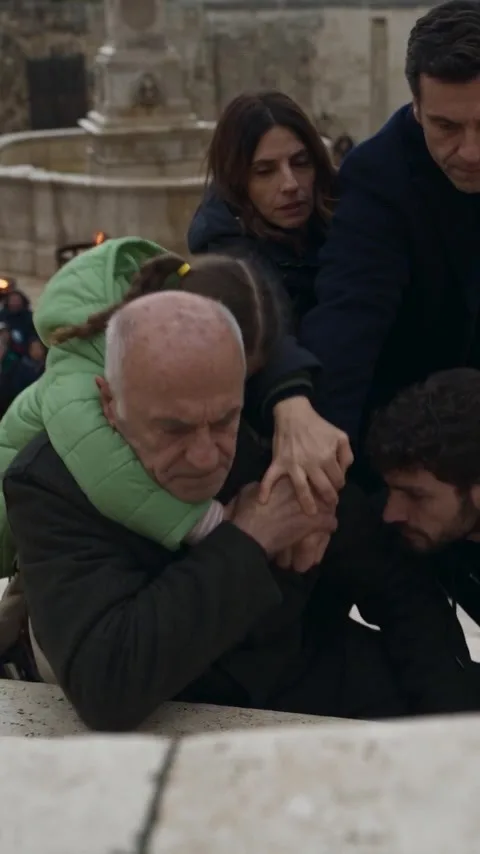
The bell had just stopped, and the wet stone was still ringing when Bianca let go of her hand.
Silvia noticed it the way she noticed everything now - half a second late and then all at once. She had Nino's hood bunched in her right fist and the paper of dried figs in her left, and she was counting: nine weeks of unpaid wages, twenty minutes until the good coats had to come off, forty euros and change in the tin at home.
Then her daughter was gone up the steps.
The piazza was thick with the feast. Braziers of chestnut wood smoked along the fountain wall, and the fountain was dry as it always was by October, its basin full of dead leaves and cigarette ends. The crowd stood with their cups and their elbows and their opinions, and every one of those opinions had a name on it.
Bianca went straight up the second step and put both arms around the old man's neck.
Silvia heard her own voice come out flat. "Bianca. Come here."
Her daughter did not turn. Her daughter had done this before. That was the thing Silvia's body understood before her mind did - the casualness of it, the fit of it, the way Bianca's cheek found the old canvas of his coat without looking.
Nino peeled off her other hand and went up after his sister, straight for the tobacco tin in the coat pocket, as though it were his own drawer in his own room.
The crowd stopped talking.
Nine years of Marbolina's good opinion stood behind her in chestnut smoke, all of it watching her children love the man the whole valley said had cut the fuse that killed their father.
He was filthy. He had been filthy for as long as Silvia had been aware of him, which was most of her life in this town, though it was only in the last handful of years that he had become a permanent fixture on the church steps. Flat cap, canvas jacket, wire for a belt. His left eye was milky. He sat with his back against the church door as if the door were a wall he was holding up.
"Bianca." Silvia started up the steps.
Marco Ferretti got there first.
His hand closed around her daughter's forearm and pulled, and Bianca's grip did not break, and she made a small sound, and Marco's phone was already at his ear.
"Carabinieri," he said, loud enough for the whole piazza. "Via Cavour. Now. And tell them to come up on foot."
"Let her go," Silvia said.
"She's five years old and this man has been putting his hands on her." Marco's voice carried the way it carried across the yard when a slab cracked - flat, public, useful. "You want to explain to the maresciallo why your children are climbing on the town drunk?"
The old man moved.
Nobody in Marbolina had seen him stand up in nine years. He came up off the step slowly, one hand braced, the satchel sliding on his shoulder, and he was taller than the town remembered. His right hand closed over Marco's wrist.
"Get your hands off her," he said.
The words went across the piazza and cut the murmur off mid-syllable. Even the man on the phone stopped talking.
Silvia reached them and her hand locked onto Marco's wrist from the other side. Three hands on one wrist, and a small girl's arm underneath all of it.
Marco switched the phone to his left ear. "Carabinieri. Via Cavour. Now," he said again, and then, to the steps in general, "You all heard him. He's got something to say, this one. Nine years he's been sitting on my father's steps, and now he's got something to say."
Nino pressed himself flat against the old man's knee.
Then Silvia saw the hand.
It was up and open against the wet pale marble, steadying him - the left hand, thumb tip gone clean at the first joint, the way a thumb goes when a blasting cap goes off under a man's grip. There was a scar down the right forearm, wax-slick and old.
Silvia's eyes stopped there and would not move.
"Silvietta," the old man said.
Her own childhood, out of that mouth, in front of the feast.
Nobody had called her that since her father died in Genoa. Not once. Not her mother-in-law, not Marco, not the women who had known her since she was a girl carrying water up the Canalone in a bucket with a dent in the side.
Her fingers tightened on Marco's wrist. She did not know which of them she was holding.
"Let go of my granddaughter," the old man said, "and I will say the name of the man who cut that fuse."
The piazza made a sound like a held breath being let go.
Then Father Ivo came out of the church door with his stole still crooked, and at the top of the piazza a Carabinieri car pulled in and both doors opened, and Marco - because he was, above everything, a man who knew when a crowd could be used - let go of Bianca's arm, put the phone in his pocket, and stepped back with his hands open.
"Go on, then," he said pleasantly. "Say it."
The old man looked at Marco. Then he looked at Silvia.
He looked at the Segheria Ferretti patch on her overalls, at the two children on the step below him, at the crowd behind her with all of its eyes.
He sat back down.
"Nothing to say," he said.
The piazza started talking again, and the talking went down the steps and along the fountain wall and out into the streets of the town the way water goes down a gutter. Silvia took her children by the wrists, one in each hand, and walked them down through the middle of it, and it took four minutes and felt like being undressed.
At the corner by the Camera del Lavoro, Bianca pulled back on her hand and stopped and looked up at her, entirely calm.
"He's not bad, Mamma," she said. "He holds my thumb when the mountain coughs."
Silvia stopped walking.
She had heard that sentence before. Three weeks ago, in the yard, skipping through the slurry-wet gangway between the slab racks, her daughter had sung it at the polisher like a nursery rhyme while Silvia ran the felt wheel over a headstone edge and did not look up.
She looked up now.