Chapter 1
The stove clock said 11:41 and I had one boot off.
Thursday isn't my night on the rotation. Marv takes it. So I'd come in at nine, eaten standing over the sink with my coat still on, and started peeling down in the mudroom. One boot. Socks on wet linoleum. The coffee I poured at ten had gone cold on the counter and I hadn't dumped it because dumping it meant admitting I was done for the night.
Then the radio in bay 2 cut out and came back.
That was the first thing.
The second thing was a voice.
"Seven."
I know the sound of my own building. I've been inside it since I was nineteen years old. The crusher pad, the hoist chain, the compressors, the air lines, Rufus's chain running the fence when a coon comes up off the river. There's the sound of a nut coming loose and the sound of a man tightening one, and neither of them is a number. There is no seven in my shop. Not at a quarter to twelve at night. Not in February. Not with the yard light on a timer and the office locked and my daughter asleep in the house forty feet away.
I walked the length of the kitchen with my hand out like the wall might move on me. The mudroom door was cold through my sock. I opened it.
Freezing rain. It came down thin and steady and it ticked off the shop's metal roof like somebody tapping a pencil. The pad had standing water on it. My socks were soaked through before I got to the gravel.
Rufus hit the end of his chain. He never barks at me.
Bay 2 was lit. Both doors were up on the far bay, the one we don't use until the crusher runs, and the near bay was open with the sodium light over the corner throwing that flickery orange across the concrete, and my husband's shadow was laid out long on the pallet.
He'd left the radio on.
I stopped two steps inside the door.
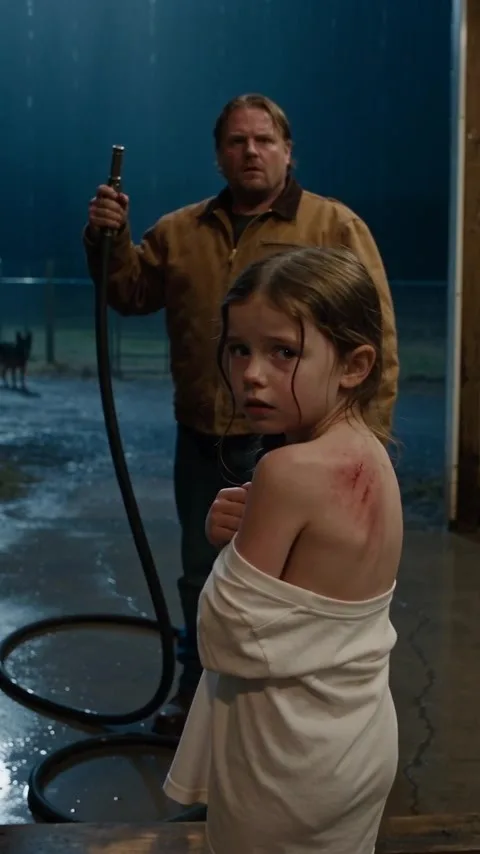
My daughter stood on a wet wooden pallet with her back to me and her white undershirt bunched up in both hands against her chest. She was bare from the waist up. There was a red band across her left shoulder blade, one clean line, so bright it looked painted.
Clay stood behind her and a little left, and he had the black heater hose doubled in his right fist.
He never raised his voice. That's the thing people don't understand about him. He doesn't yell. He explains. He's the man who shows up when your well pump dies and hauls your junk for free and coaches T-ball on Saturdays, and when he talks it comes out even as a man reading a gauge.
"Seven," he'd said.
I said my daughter's name.
"Nora."
She didn't scream. She didn't run to me. She turned her head about half an inch and her face went flat, all the way flat, and I have thought about that face every day since. It wasn't fear I saw on it. It was worse. She looked like a kid who'd been caught.
Clay hooked the hose back on its nail in one motion, like a man putting a wrench away, and turned around.
"Go on inside, sweetheart," he said to her. Then to me, calm, wiping his palms on his jeans: "She's been in my console again. Forty dollars. I told her last week we were past talking."
Nora pulled her shirt down over her head.
"Clay."
"She pulled away from me and went down on the pallet corner." He said it the way he'd tell me the rotator needs a wheel seal. "Look at it. She's fine. It's over."
The hose on the wall had two lengths of it laid together, doubled back, and I could see the crease where it had been held.
I said, "Okay."
I said okay, and I heard myself say it, and I still don't know which one of us I was convincing.
He walked Nora across the gravel with his hand on the back of her neck, light, the way you'd steer a calf, and I followed with my wet socks squelching, and in the mudroom I got her out of the wet hoodie and turned her toward the light.
She wouldn't let me see her back. She folded her arms over her chest in a way that made her look about six.
"I'm sorry," she said.
I got her into bed and she lay facing the wall with the blanket up to her ear. Rufus barked twice, hard, down at the north fence, at the doghouse side of the run, where he's never once let Clay walk.
I stood in the hall and watched my daughter's eyes slide toward that window and then away.