Chapter 1
My son came up the lawn holding the hand of a woman who was supposed to be in Europe.
He was eight, he had grass stains on both knees, and he was talking the way he talks when he has found something better than the party.
"This is the garden lady," Oliver said. "She knows the name of every rose. Even the ones that are dying."
The terrace went quiet in a way I had never heard it go quiet. Forty people, the foundation board, two bartenders, one cellist. Every glass stopped halfway to a mouth.
Verity Halloran set hers down on the stone rail without a sound.
She was fifty-four and looked it the way money lets you look it. White linen suit, silk blouse, blonde bob set so hard it didn't move when she turned her head. On her right hand, the heavy gold signet ring with the family seal. Under her left arm, the leather folder she had carried all afternoon like a purse.
Inside that folder was the transfer of Briar Glen to the Halloran Foundation. Everyone on that terrace knew she was signing it tonight.
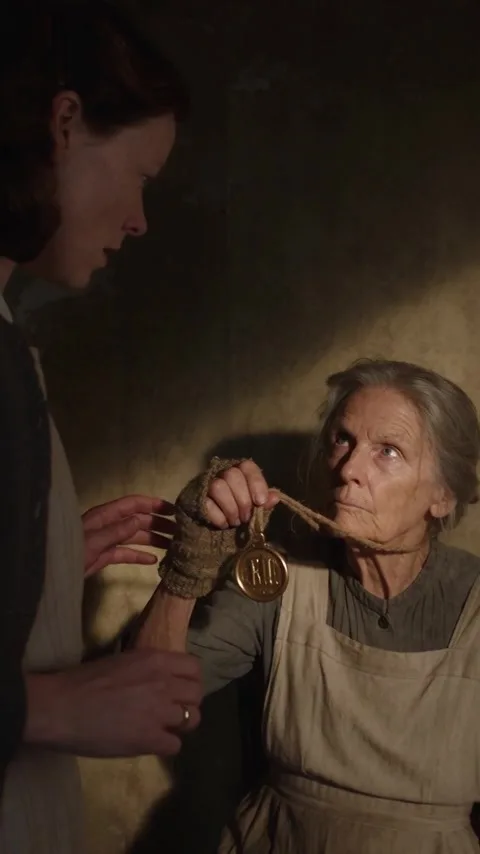
The woman holding my son's hand was thin as a fence post. Faded cotton dress, canvas apron, gloves tucked into the apron pocket. Silver-grey hair tied back with twine. Her face was sun-weathered and gaunt and calm, and she was looking at Verity, not at me.
Around her throat, on a frayed blue ribbon, hung a small brass key.
"I found her by the hedge," Oliver said. "She was pulling weeds out of the boxwoods. She says the boxwoods are older than the house."
Verity crossed the terrace. She smiled down at my son and put her hand on the back of his neck, gentle as a collar.
"Oliver, sweetheart. Go find your father."
He went. He always went. That's the thing about this family - everyone goes where Verity points.
I stood up. The woman had already turned and started back down the lawn, unhurried, her hands loose at her sides.
"Who is she?" I asked.
"She does the roses," Verity said.
"I've been coming here twelve years. I've never seen her."
"You've seen her. You just haven't looked." Verity straightened a fork on the rail and picked up her folder. "Enjoy the evening, Dara."
She walked off, and the party came back on behind her like a switch.
I stood there with a plate in my hand. Down the slope, the woman reached the hedge wall at the bottom of the garden - that long black run of yew and boxwood that separates the lawn from the east wing's gravel path. She put one hand into it, the way you'd part a curtain.
And she stepped through.
I watched for a full minute. The cellist started up again. Somebody laughed at something on the far side of the terrace. Nobody came out the other side of that hedge, and nobody could have, because I had walked that wall a hundred times with Oliver and there was no gap in it. Not one. It was planted solid in 1908 and it had never been opened.
I set my plate down.
I am forty-one years old. I am a veterinary technician and I keep the foundation's books four mornings a week, and in twelve years in this family I have never once been allowed to ask a question that mattered.
I asked one that night. I just didn't know yet what it was.