Chapter 1
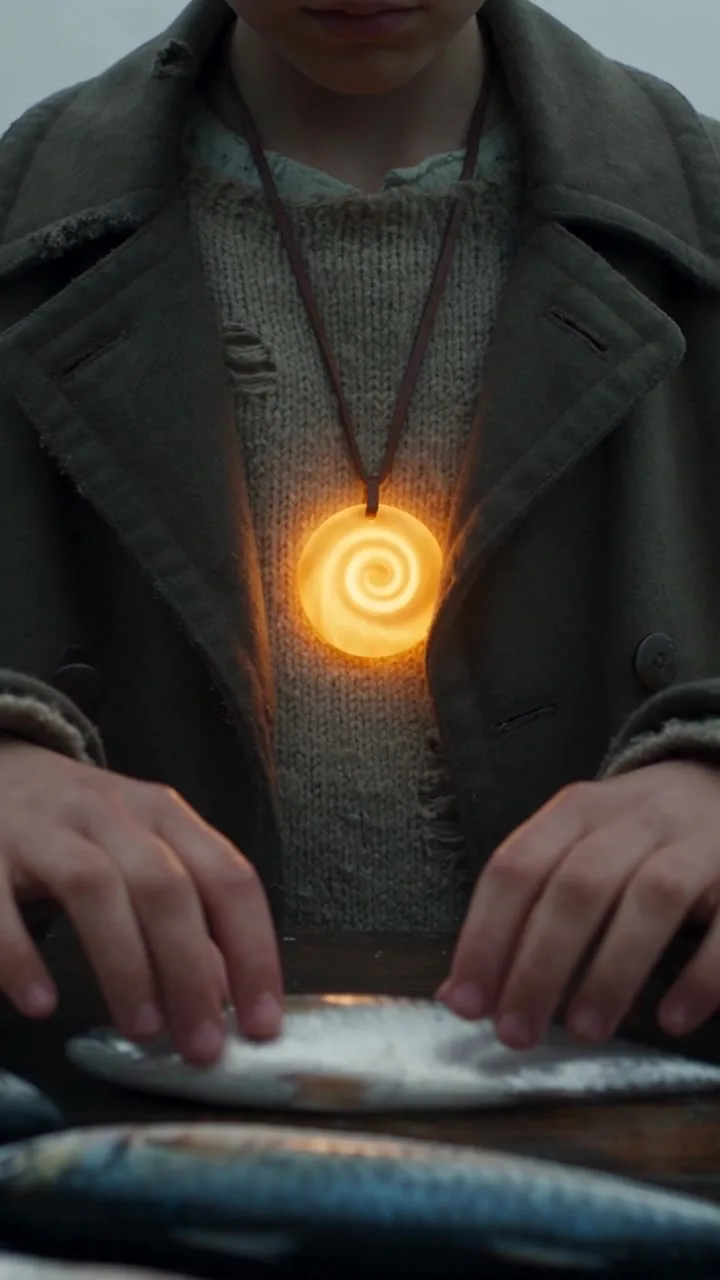
I had the fish under my coat before the fishmonger turned around.
He was haggling with a woman over crab, his back to the table, and the hake lay in the wet slush with one cloudy eye. My hand knew the distance by then. Close to the body, no flourish. Silver and cold against my ribs.
Then the cord around my neck went hot.
Not warm. Hot, like a spoon left in a kettle. I gasped and clamped my hand over my sternum. Under the wool, the fork was glowing. I could see the shape of it through the sweater, pale light leaking between my fingers.
"What did you do, girl?" said the man at the next stall.
Fenn Marrow. Oilskin apron, wool cap, hands full of gut. He'd watched me circle the market for an hour and said nothing, which is the closest thing to charity the fish quay gives. Now he was staring past my shoulder, out at the harbor mouth.
I turned.
The Wick had been dark since before I could remember. Fifteen years of black stone on black rock, and sailors used it as a landmark the way you use a dead tree. Now its lamp burned gold. One long pulse, brighter than the sun behind the cloud, and every wet cobblestone in the market threw a shadow.
The whole quay went quiet. Even the gulls.
A garrison whistle cut the morning in half.
I ran. Bare feet, wet stone, the hake sliding against my ribs. I shoved between two stalls and a woman screamed at me and I didn't stop. Behind me boots hit the cobbles in a rhythm I knew too well, the flat slap of garrison issue, four of them at least, and a voice shouting for the crowd to part.
Crab traps. Five of them stacked against a wall by the ice house, wood and net, smelling of rot and salt. I dropped and wedged myself into the gap, back to the netting, chest heaving. The glow in my shirt guttered down to an ember and died.
I got three breaths. Then the boots came, slow now, and stopped.
A shadow slid across the wet stones in front of me, long and thin, and then it fell over my face and everything went dark.
They hauled me up the bluff by one wrist. The garrison yard smelled of horse and tar, and the men who held me didn't bother to be careful. My shoulder made a sound I didn't like. The fish fell out of my coat somewhere on the stairs and nobody cared, least of all me.
Commander Elias Rusk stood at the rail of the yard with his back to the harbor. Navy coat, tarnished brass, boots worn soft at the heels. A rope burn scar crossed his throat like somebody had once tried to hang him and changed their mind. He was fifty or close to it, and every dockworker in Kellbridge hated him in a way that had gone quiet and permanent, the way you hate weather.
"Leave her," he said.
The men let go. I stayed on my knees because standing seemed like a promise I couldn't keep.
Rusk came closer. He looked at my face first, the way a man looks at a tool he might buy. Then his eyes went down to the cord at my neck, where the fork hung out of my collar now, pale bronze, grooved in a slow spiral, still warm.
His hand shook.
He was a man who had spent fifteen years not showing anything, and his hand shook, and he did not seem able to stop it. He took the fork between two fingers and turned it toward the gray light.
"Where did you get this?"
"My mother."
"Her name."
"I don't say it to garrison men."
Something moved behind his eyes. He let the fork drop against my chest and stepped back, and his jaw worked once, twice.
"Get up," he said. "Go down the hill. Be past the city walls by dawn. If anyone asks your name, you're from Ferrow. Say it."
"Why?"
"Because I'm not going to hang a child for a fish," he said. "Go."
I went.
But the garrison yard sat on the bluff above the harbor, and when I reached the rail I stopped, because the tide was at slack low and the water had pulled off the drowned lower district like a blanket off a corpse.
I had heard about it my whole life. A storm surge, they said, fifteen years back. Four hundred houses under the tide line. You could see it now in the gray light: rooflines, a whole street of mud, a chimney standing alone with a cormorant on it. The tide had uncovered the small houses nearest the old seawall, and one of them had a red door, faded to pink, still shut.
I knew that door.
I was six years old in a freezing room with a stove that wouldn't draw, and my mother was coughing into a rag, and she told me to keep the fork under my shirt and never show it to anyone, and there was a red door. There was a red door and there was salt on the window and she died in that room and I got taken up to the orphan quarter and the door got taken by the water.
Fifteen years of tide. Somebody put that street down there on purpose.
Behind me, in the yard, a corporal was already repeating my description to a runner. Barefoot. Dark hair, cut bad. Girl.
I turned away from the city gate and went down the hill toward the quay instead.