Chapter 1
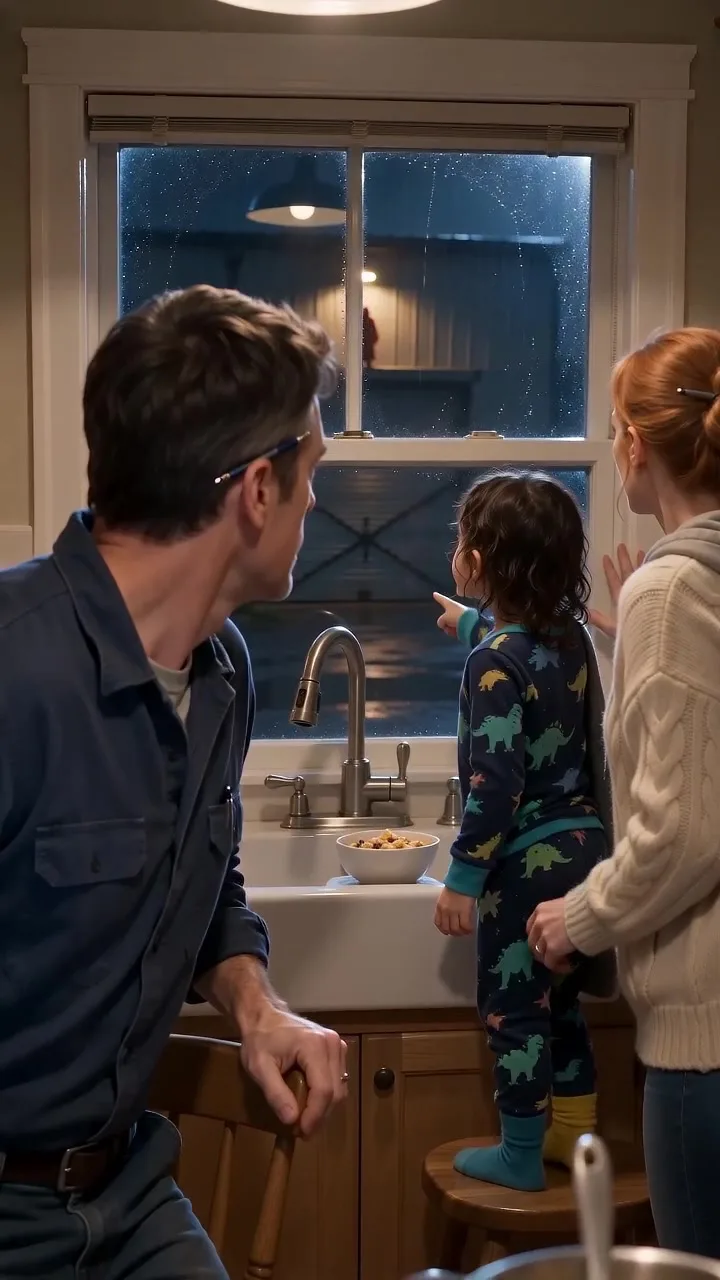
I had a pen in my hand when my daughter said it, and I signed the invoice anyway. That is the whole man, right there, in one line of wet ink.
"Mama. There's a girl in the ice house window. She's been watching us since supper."
Josie said it the way she'd announce the school bus. She was standing on a kitchen chair at the sink with her bowl of Cheerios in both hands, up on her toes, my mother's old cardigan sliding off one shoulder. Six years old, one blue sock, one yellow.
Cori was at the stove. I was at the table with the laptop and the invoices, back three-quarters to the window, because that is how I sit. You learn to keep your back to things.
"Mm," Cori said. She didn't turn around. It was forty minutes past dark and raining the kind of cold October rain that comes off the river and puts a hand on the house.
"She's got a thermos," Josie said.
I want to be honest about what I was feeling, which was nothing yet. Tired. Behind on a furnace job over on Larch. Not afraid. That came about forty seconds later.
Cori crossed the kitchen with the wooden spoon still in her hand and stood at the sink with our daughter and looked out across the wet gravel of the alley. I got up and looked too, because that is what a normal man does.
Thirty-two feet of standing water. The boards I'd meant to fix in August. The loading dock with a chain threaded through the door handles and rust layered over the padlock. The soaped-up windows we stopped bothering with after the city cut the power in 2011. The dead building my father built and my brother was run out of town over.
And one yellow bug light burning over the dock, which was impossible, because there is no power in that building.
Above it, in the second-floor office window, a small figure stood in a red hooded coat. Dry. Still. Holding a dented steel thermos.
"The girl," Josie said, patient, because I was being slow. "She says her daddy didn't take the money. She says you know who did."
Here is what I cannot explain to anybody, not to Cori and not to the deputy and not to the county. That sentence went through me like a nail through a two-by-four, and what came out of my mouth was not a question. It was not take what money or whose daddy or Josie, what did I tell you about talking to people out that window.
"I don't know her."
Nobody had asked me anything.
The rain kept on the glass. Josie climbed down off the chair and set her bowl on the sill. One Cheerio stuck to the rim. That bowl sat there until Saturday and I never moved it.
Cori's spoon stopped over the pot. Not the stop of a woman thinking about dinner. Then she laid the spoon on the rest and turned away from the window, and she did not look at the dead building again. She looked at me, and the room got small.
"Nate," she said. One word.
Cori has a face that tells the truth before she does. Hazel eyes, freckles across the nose, brows that go up when she's being polite to somebody she doesn't like and down flat when she's done being polite. The brows were down flat.
"I was going to ask if you knew her," she said. "I hadn't asked yet."
My hand was still on the pen. I made myself put it down slowly, because I had the thought - pure reflex, sixteen years of reflex - that I needed to look like a man with nothing to hide. Setting a pen down slowly felt like something that man would do.
"I don't know her," I said again.
Two lies in thirty seconds. A record for me. The first one was even true. I have never met that child. That is the terrible part. It is true and it is the least useful true thing I have ever said out loud.
Josie came back to the table and put her warm hand on my wrist.
"She says it's important," she said. "She says she's been waiting a long time and she isn't supposed to say more than that."
"Who told her to say it?" Cori asked. She crouched down, but she crouched so she was looking at me while she talked to our daughter. "Bug, listen. Did somebody give her that sentence? Did somebody tell her to tell you?"
Josie thought about it the way she thinks about everything, in order. "I asked her who her daddy was and she said Dean. And I said my daddy is Nate, and she said that's what she thought. Then she gave me the sentence."
The rain came harder.
Cori stood. She went back to the window one more time and looked out at that yellow light for ten or fifteen seconds, and I watched her back and her shoulders and how still she went. Then she pulled her coat off the hook and dropped it over the back of a chair, which meant she wasn't leaving yet.
"Somebody put that child in a building with no power and a chain on the door," she said. "In October. In this."
"Her grandma might-"
"Nate." Flat. "Why did you answer before I asked?"
There it was.
I could have put the whole sixteen years down on the table between the invoices and the chicken and rice. I want that on the record. I knew it was the moment.
Instead I looked at the invoices.